• Sale!

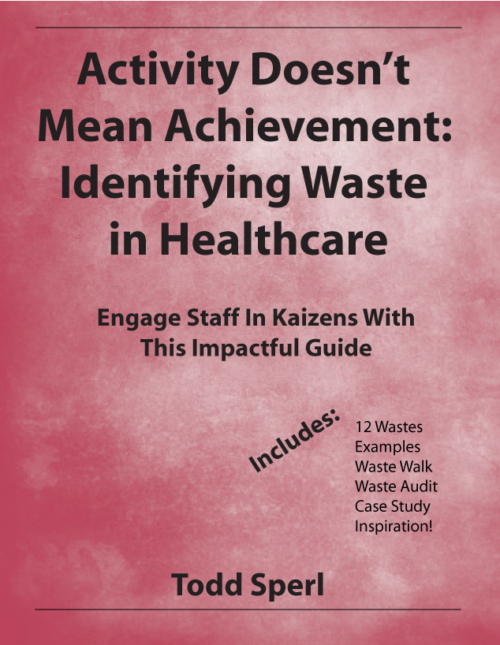
    Activity Doesn’t Mean Achievement: Identifying Waste in Healthcare

    Original price was: $9.95.Current price is: $7.95.
    By: Todd Sperl Activity Doesn’t Mean Achievement: Identifying Waste in Healthcare provides a practical approach to educate and communicate to healthcare staff on the various types of wastes that may exist in their processes as well as provide guidance in possible ways to eliminate those wastes.  Subsequently, individuals and teams can work to eliminate those specific wastes through Kaizen or Rapid Improvement Events.  The purpose of this book is to provide:
    1. A standard communication platform for defining the 12 wastes for an individual as well as a team
    2. EXAMPLES of healthcare waste that may “trigger” ideas of wasteful processes in your facility
    3. Questions to help DETECT wastes in current processes
    4. Suggestions of Lean and Six Sigma methods to ELIMINATE wastes
    5.  Innovative ways to conduct a Waste Walk
    6.  An example of a Waste Audit and Waste Walk
    7. Space in the book to document current wasteful processes as well as ideas for eliminating those wastes
    8. Definitions for the basic Lean and Six Sigma tools
    9. A case study on how one facility used the simple concept of waste to engage staff in their Lean journey
  • By: Rob Ptacek, Todd Sperl, Jayant Trewn (PhD), and Deborah Salimi (PhD)
    Note:  Currently out of stock for hard copy.   We Print-On-Demand for this title of quantities of 20 or more.  Please call 734-475-4301 to place your order.

    Your eBook will be provided as a downloaded file.

    The download PDF book provided is to be distributed to the quantity purchased. Unauthorized copying or sharing is not permitted. Please email info@theleanstore.com or call 734-475-4301 if you have any questions on the ebook(s) purchase.  EG., if you purchase 5 copies of a book will allow you to distribute the PDF to 5 users.
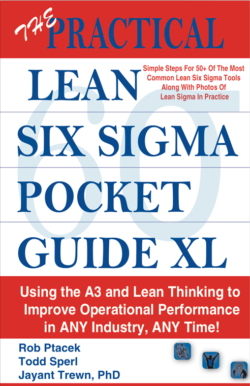
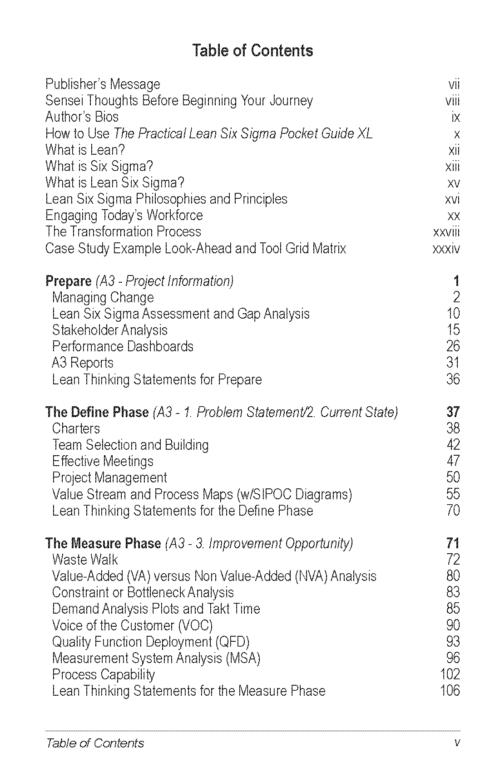
    The Practical Lean Six Sigma Pocket Guide XL bridges the gap between a highly quantitative analysis of a process that requires extensive training (i.e., Six Sigma certification) and a more simplified approach that can be used and understood by the masses (i.e., Lean thinking).  This book make the methods and tools of Lean and Six Sigma accessible to more people and provide a common sense or “practical” approach to problem solving and continuous improvement. Over 40 of the most common Lean Sigma tools are clearly define with a step-by-step approach, checklists, forms and worksheet examples, as well as case study examples from office/service (administrative), retail, healthcare, financial, travel services, and manufacturing.  The broad examples will allow employees to fully understand the “practicality” and universal application these tools provide.  Therefore, with that information, the ability to apply the tool or concept to their processes will be that much more successful.
Go to Top